
Curbside Compostables
When food and other compostable material end up in the garbage, they use up a lot of valuable space in our landfill. By composting, you will help produce less garbage, turn waste into nutrient-rich compost for farmers/landscapers, and reduce methane production at the landfill.
The collection schedule and cart requirements for compostable waste remain unchanged from the previous program.
Compostable waste will continue to be collected weekly using your green cart. Residents may also set out up to 10 additional paper yard waste bags or bundled branches per week, year-round.

Compostables (Organics) Diversion - Help Keep Waste out of the Landfill
Keeping compostable waste out of the landfill
The Fraser Valley Regional District is taking steps to divert compostable material from disposal, a priority in the FVRD Solid Waste Management Plan. To support the regional efforts, the City of Chilliwack has modified our Residential Curbside Collection Program to separate organics/compostables (food waste, food-soiled paper and yard waste) for composting.
The City has also been working with the FVRD to expand compostables diversion to other sectors such as multi-family residences, businesses, schools, and health facilities. The FVRD's Solid Waste Removal Regulations Bylaw came into effect in 2020 and requires all residential, commercial and institutional properties in the region, including Chilliwack, to separate compostables and recyclables from garbage. For more information, click here. The same source separation requirements are in the City's Solid Waste Management Bylaw.
Why is it important to compost?
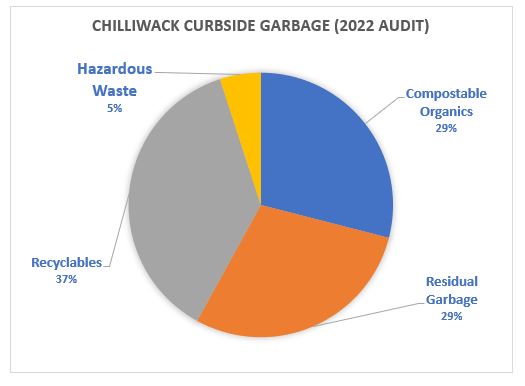
When food and other compostable materials end up in the garbage, they use up a lot of valuable space in our landfill. This space is limited and we can separate our compost to divert compostable organics such as food waste from our landfills. It is estimated that a third of what we send to the landfill in our region can be composted and a significant amount of compostable waste is generated by residents. A waste audit conducted for single-family residences in Chilliwack in 2022 showed that compostable waste comprised over 29% of the total garbage stream:
The diversion of compostable material from the landfill will have several other benefits:
- Less odour generation
- Less attractants for rodents, birds, and wildlife
- Less greenhouse gas generation
When compostable material breaks down inside a landfill site where there is no oxygen, it generates methane, which is a greenhouse gas 23 times more powerful than carbon dioxide. Although we now have a gas collection system at the Bailey Landfill, it is impossible to collect all of the gas generated. In just one year, the gas extraction system collected over 1 million cubic metres of methane or 14,000 tonnes of landfill gas. If compostable material is diverted from the landfill in the future, the gas collection system is still required because historic food waste disposed of at the landfill will continue to generate methane for years to come.
By participating in the City’s Compostable Collection Program, you will:
- Produce less garbage because food waste makes up over 40% of residential garbage.
- Turn waste into a resource by transforming this compostable waste into nutrient-rich compost for farmers and landscapers.
- Contribute to cleaner air by reducing methane production at the landfill.
What goes in Curbside Compostables?
Below is a list of materials accepted in the green cart.
Reminder: Please do not use plastic bags/liners, including those marked compostable/biodegradable as these are not accepted at the composting facility. They do not break down and get caught in machinery.

Items not accepted in Curbside Compostables
Keeping contaminants out can ensure the final product of compost is at its highest quality.
Below is a list of materials NOT accepted in the green cart.

Extra Yard Waste - New Requirements
- Residents can put out up to 10 extra paper bags of yard waste or bundles of branches per week, year-round (no tag-a-bag stickers required).
- Branches can be tied in bundles of no more than 0.6 metres (2ft) in length with a diameter no more than 0.3 metres (1ft). The diameter of each branch can be up to 15 cm.

- You can also bring extra yard waste to the Parr Road Green Depot for a small fee. They provide an alternative option for disposing of clean wood and yard waste, including stumps, logs, log cut-offs, firewood, and tree trimmings over 360 mm in diameter. The depot also offers clean soil products for purchase. For more information, please visit the Parr Road Green Depot page.
- Yard waste is also accepted at the Bailey Sanitary Landfill for a small fee. For more information, please visit the Bailey Sanitary Landfill page.
Green Cart Tips

- If you choose to line your green cart, please use a paper product such as a Kraft bag, newspaper, or soiled pizza box. Plastic bags labelled compostable or biodegradable are not permitted.
- All compostable waste must fit inside the green cart, and the lid must be closed. Do not pack the cart down forcefully, or the tightly packed waste may get stuck in the cart, and it will not empty properly.
- Unlock your 80L or 120L green cart with a twist lock before placing it at the curb for collection.
Curbside Compostable - Frequently Asked Questions
Q1: What happens to the compostables that are collected?
Instead of becoming waste at the landfill, food waste, yard waste, and food-soiled paper are taken to a processing facility in Eastgate, BC, where they are turned into compost.
Q2: Is food waste in the landfill really a bad thing? Doesn’t this material break down into compost or soil anyway?
Food waste does not break down into compost or soil in the landfill because it needs oxygen to decompose properly. When this material is placed in the landfill, it gets mixed up with other garbage and is quickly compacted and buried.
Often, the garbage stays in an airless environment and very slowly breaks down. This process can take decades. As it slowly breaks down, the food waste releases significant amounts of methane, a strong greenhouse gas. The Bailey Landfill is equipped with a landfill gas collection system, but it is best to minimize methane generation in the first place.
Q3: I have a garburator; why should I participate in the curbside compostables collection program instead?
The curbside compostables program allows you to put your food waste to good use by placing it in your green cart for composting. Unlike composting, using garburators puts unnecessary strain on the City’s Waste Water Treatment Plant. If everyone were to use a garburator instead of composting, the City would have to carry out expensive upgrades to the Waste Water Treatment Plan in order to handle the extra nutrient loading. Composting at curbside is easy; it creates good soil and saves energy, water and your plumbing too!
Q4: Am I still able to use my backyard composter?
Yes, if you have a backyard composter, please feel free to continue using it. The compostables collection program complements backyard composting by accepting a wider range of food waste that may not be suitable for backyard composting, such as cooked food, meat, bones, fish, baked goods, food-soiled paper products, including paper towels and napkins, and paper food-soiled packaging such as used paper cups and paper plates and larger diameter yard trimmings.
Kitchen Catcher
Resident can use a “Kitchen Catcher” to store food waste in the kitchen before transferring it to the green cart. Kitchen catchers are designed for indoor use and NOT acceptable at the curb for pick up. Residents can line their kitchen catcher with old newspaper or brown paper bags to make cleaning easier, but please do not use plastic bags/liners, including those marked compostable/biodegradable, as these are not accepted at the composting facility. They do not break down and get caught in machinery. Kitchen catchers are available for purchase at any hardware stores but you can also use an ice cream bucket or a coffee tin.
How is compost made in the FVRD?
Watch this video to see how compost is made from curbside organic materials such as food scraps and yard waste.
Compostable waste generated in Chilliwack is processed by Net Zero Waste, located in East Gate, BC.
| Attachments | |||
| Description | Date | File Size | |
 |
Curbside Sorting Guide - 2025 | 2025-03-03 | 6.44MB |
|
Green Cart Tips - 2023 | 2023-06-07 | 262KB |
|
Quick Reference Guide - 2025 | 2025-03-03 | 431KB |